
Formally known as the Terrorism (Protection of Premises) Act 2025, the legislation introduces a legal duty for organisations to consider the threat of terrorism and take practical steps to improve public safety.
While the law introduces new compliance requirements, its wider goal is clear: to ensure that venues, events and public spaces are better prepared to protect people in the event of a terrorist attack.
For many organisations, this will require a shift in how security planning, risk management and crisis response are approached.
Why Martyn’s Law Is Being Implemented
Martyn’s Law was introduced following the tragic Manchester Arena bombing in 2017, in which 22 people lost their lives.
Among them was Martyn Hett, whose mother Figen Murray launched a campaign calling for stronger protections at publicly accessible venues.
In the years following the attack, reviews highlighted that many organisations lacked consistent procedures for responding to terrorist threats. While counter‑terrorism policing in the UK is highly developed, preparedness at venue level varied significantly.
Martyn’s Law was therefore developed to ensure that organisations responsible for public spaces understand the risk of terrorism, implement proportionate security measures, and ensure staff know how to respond during an incident.
What the Law Requires
At its core, Martyn’s Law requires organisations to consider terrorism as part of their security planning and take appropriate steps to reduce risk.
The legislation introduces a duty for those responsible for certain premises or events to assess the risk of terrorist activity, implement measures to reduce vulnerabilities, prepare procedures for responding to incidents, and ensure staff are aware of how to react during an emergency.
Oversight and enforcement are expected to be managed by the Security Industry Authority (SIA).Which Organisations Will Be Affected?
Martyn’s Law applies to publicly accessible locations where people gather. Examples include shopping centres, restaurants, music venues, stadiums, museums, public buildings, places of worship and large public events.
In practice, any organisation responsible for a location where members of the public can freely access facilities may fall within scope.
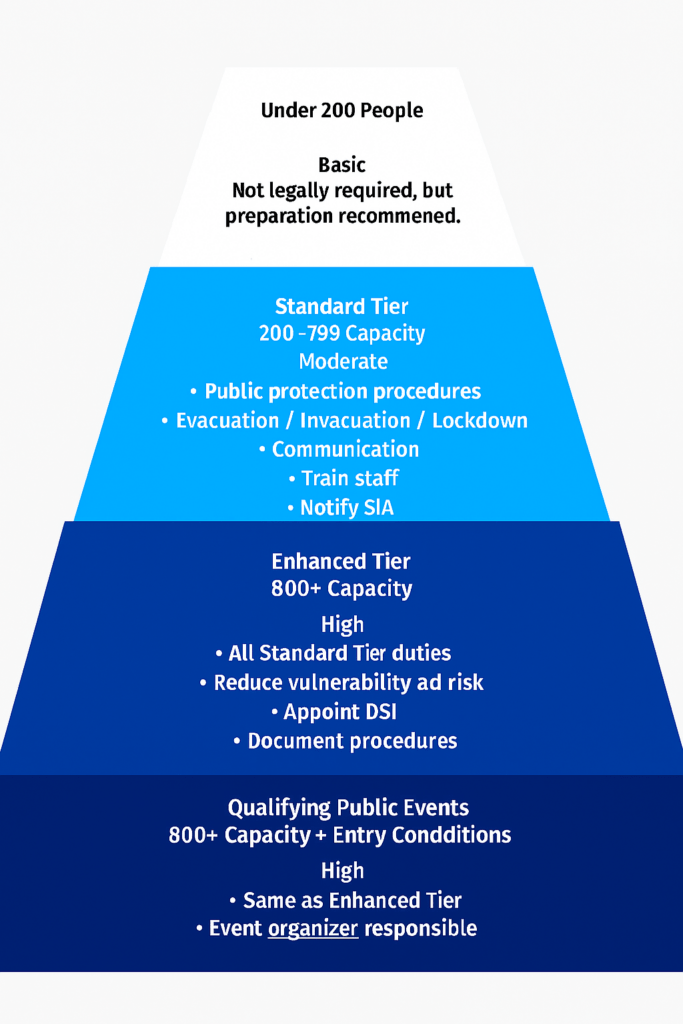
Potential Penalties for Non‑Compliance
Potential Penalties for Non‑Compliance
While the primary goal of Martyn’s Law is preparedness rather than punishment, enforcement measures may include fines of up to £10,000 for Standard Tier organisations and up to £18 million or 5% of global turnover for Enhanced Tier organisations in serious cases.
For Standard Tier venues, compliance may involve staff awareness training, emergency planning procedures and evacuation planning.
Enhanced Tier organisations will likely require formal risk assessments, documented security plans and coordinated incident response procedures.
How Technology Can Support Martyn’s Law Compliance
For organisations operating in the Enhanced Tier, technology will play an important role in managing security preparedness and response.
Solutions such as those provided by F24 can help organisations rapidly communicate during incidents, coordinate crisis response teams, maintain documentation and audit trails, and run preparedness exercises to strengthen organisational resilience.
Preparing for the Future of Public Safety
Martyn’s Law represents a significant step forward in strengthening security across the UK’s public spaces.
For organisations responsible for venues and events, the legislation introduces new responsibilities but also an opportunity to improve resilience, preparedness and public safety.
By combining clear procedures, trained staff and the right technology, organisations can ensure they are ready to meet the expectations of the new law while protecting the people who rely on them.

Contributed by F24 Experts
As the UK moves closer to implementing Martyn’s Law, new legislation designed to improve security and preparedness at publicly accessible locations, organisations of all sizes must understand what it means for them. But with evolving requirements, varying tiers, and ongoing questions around compliance, many businesses are left wondering: Are we truly ready?
F24’s Harrison King demystifies Martyn’s Law and equips you with the knowledge you need to take action.