Efficiently mastering crises in the financial and banking sector
The financial sector requires special precautions to be resilient against risks. Banks, financial trading companies, and stock exchanges must be able to demonstrate stability at all times. The financial sector requires special precautions to deal with risks resiliently. Banks, financial trading companies, and stock exchanges must guarantee demonstrable stability at all times. Regulatory pressure is correspondingly high. The be-all and end-all for all financial service providers is a robust emergency and crisis management cyber resilience strategy. Learn here how to stay flexible in banking and finance with smart alerting and GRC tools.


A safety net for critical infrastructures
The financial sector is one of the critical infrastructures, together with energy, ICT infrastructure, and food production. In short, this means financial institutions must not fail. Effective risk management in the financial industry is essential for a stable economy. A secure, independent crisis management system provides valuable support to risk managers and responsible stakeholders in implementing emergency measures and maintaining business operations. Cloud-based alerting and communication systems ensure that the crisis team is always capable of acting, even while on the move and across different devices.
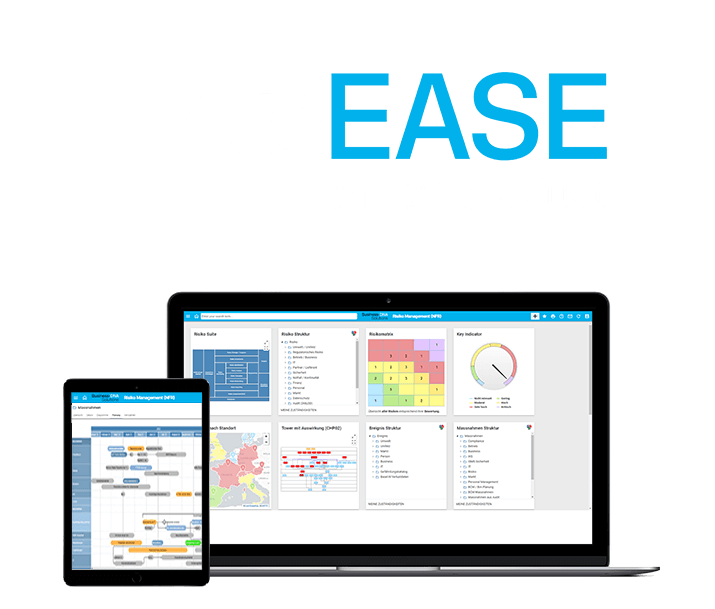
In addition, the structured interlinking of risks, controls, processes, outsourcing arrangements, and critical services is becoming increasingly important. Transparent dependencies, automated analyses, and audit-proof documentation create a solid basis for regulatory evidence and informed management decisions. These requirements are often implemented in the form of integrated GRC software solutions. A holistic view of all corporate structures is especially relevant in critical infrastructure sectors. In GRC tools, this is often possible through heat maps, risk matrices, or digital twins of organizations.
More than 5.500 Customers from All Industries
Trust the Services of F24 in Critical Situations.





Success Stories of our customers
Raiffeisenbank Voralberg
“Flawless communication flow in both directions is crucial during an emergency and its value should never be underestimated. We became acutely aware of this yet again at the beginning of the Coronavirus crisis. If we had been using FACT24 at that time, we would have saved ourselves a lot of work” – Manfred Arquin, Raiffeisenlandesbank Security Officer
DWP Bank
“Our IT systems are subject to increasing complex requirements of availability and stability. FACT24’s automated communication technology provides vital assistance in the event of emergency.” – Thorsten Felix, deputy emergency operations officer at dwpbank
Learn more about the use of FACT24 at Raiffeisenbank Vorarlberg and download the complete case study!
Find out more about using FACT24 at dwpbank and download the complete case study now!
Strengthen your company’s resilience – through a holistic view of all elements and interrelationships
For financial institutions, resilience means managing regulatory requirements, risks, and operational dependencies in a structured and integrated manner. Relevant modules such as BCM/BIA, risk management (NFR), ICS, DORA, outsourcing, and OCIR link processes, controls, assets, and third parties on a consistent data basis. This creates transparency, ensures compliance, and sustainably increases your operational stability.
Get to know our GRC tool TopEase in more detail and schedule a demo of the solution:
How to reduce business interruptions at banks and financial institutions
Financial institutions need a connected communication infrastructure. Only when panic alarms are linked to a crisis center, for example, is it possible to respond quickly to physical threats. If a silent alarm is triggered in the trading room or a suspicious object is reported in the teller area via the panic button, countermeasures can be initiated immediately. In principle, panic alarms should be easily accessible for all potentially affected persons, while silent alarms must be placed discreetly and be triggerable unnoticed in order not to escalate a hazardous situation.
More on discreet alerting with silent alarms
It is not only physical incidents that require the highest level of attention. Digital attack surfaces, complex IT landscapes, regulatory requirements, and dependence on third parties are equally relevant. Sustainable protection only emerges when security, risk, and governance structures are interlinked. Integrated management creates clarity regarding responsibilities, interdependencies, and priorities for action, making it possible to maintain stability, compliance, and operational performance at a controlled level over the long term.
However, effective alerting alone is not enough. For security measures to help reduce business interruptions, they must be embedded in an overarching GRC and holistic resilience concept. In addition to alerting and crisis management, GRC also plays an important role. Governance defines clear responsibilities and decision-making paths in the event of a crisis. Risk management evaluates potential threats ranging from physical violence to organizational weaknesses and prioritizes the corresponding protective measures. Compliance ensures that legal requirements and regulatory obligations, for example in the areas of data protection, reporting obligations, or security standards are met.
For banks and financial institutions, this interlinking of discreet alerting and GRC means one thing above all: greater resilience. Threats are identified more quickly, responses are coordinated and traceable, and regulatory requirements are considered from the outset. In this way, not only can people and assets be better protected, but business interruptions can also be minimized and the confidence of customers, partners, and supervisory authorities strengthened. In this way, threats can be detected more quickly, teams respond in a coordinated and transparent manner, and companies take regulatory requirements into account from the very beginning. This enables them to protect people and assets more effectively, minimize business interruptions, and strengthen the trust of customers, partners, and supervisory authorities.

Certification and Information Security
In 2010, we became the first company ever worldwide to have our integrated management system for information security (ISMS) and business continuity (BCMS) certified by “The British Standards Institution” (BSI). Since our clients have the highest expectations for security and availability, we deliver nothing less. The BSI certification confirms that F24 operates an integrated management system for critical business processes in accordance with ISO/IEC 27001:2022 and ISO 22301:2019 international standards. We are also GDPR compliant to ensure utmost data protection.
Regulatory requirements for banks: DORA, OCIR, and KRITIS in focus
Regulatory requirements for banks and financial institutions are continuously increasing.
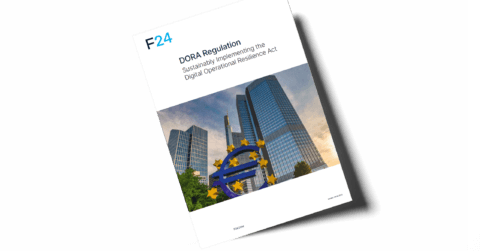
With the Digital Operational Resilience Act (DORA), the EU obliges financial companies to implement structured ICT risk management, clear reporting processes for security incidents, comprehensive third-party management, and regular resilience testing. The goal? Demonstrable digital operational resilience throughout the entire financial sector.
Operational Continuity in Resolution (OCIR) is also becoming increasingly important for larger institutions. Critical services, processes, and dependencies must remain stable and transparently representable even in the event of resolution. In addition, systemically important banks, as part of the KRITIS infrastructure, are subject to further security requirements.
Operational resilience in the financial sector means managing regulatory compliance, risk management, business continuity, and governance in an integrated way. With clear documentation, transparent dependency analysis, and robust foundations for decision-making.


Related Solutions

Product Finder
Find solutions that can suit your needs in case of emergency.

F24 SaaS-Solutions
Check out our range of smart solutions.

Business Continuity Management
Learn how to digital solutions can support to ensure business continuity.

Benefit from F24’s Smart Solutions for Finance
Talk to F24’s experts about your preparedness and crisis management plans. We are the trusted service provider for many banks and financial institutions and have experience in integrating panic alarm systems with threat monitoring and alerting software. Get in touch today!
United Kingdom
+44 1923 437 784
United Arab Emirates
+971 4 589 7931
Asia Pacific
+64 27 788 1120
Sweden
+46 456 360 567
Learn How Our Smart Solutions can Help You!
Fill in you personal Data